Decluttering When You Have ADHD: Why Your Home Becomes Overwhelming - and Where to Start
Why can ADHD make keeping your home organised feel so difficult? Discover practical ways to reduce clutter, decision fatigue and overwhelm - without trying to create a perfect home.
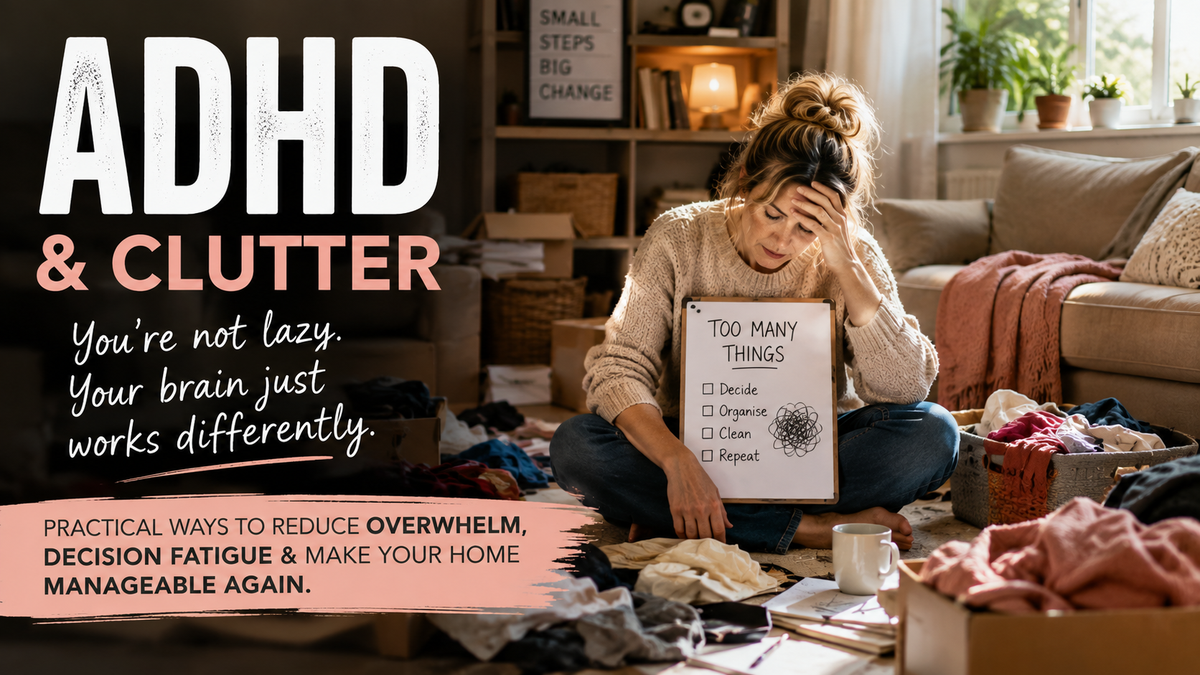
If you have ADHD and your home keeps becoming cluttered, you may have asked yourself the same question hundreds of times:
Why can't I just keep on top of it?
You tidy the kitchen.
Two days later, the worktop has disappeared.
You finally sort the bedroom chair.
Somehow, another pile begins.
You create a beautifully labelled system for paperwork and then discover three unopened envelopes underneath a shopping bag six weeks later.
And every time it happens, there's that little voice:
Other people seem able to do this. Why can't I?
But here's the thing.
Keeping a home organised requires an enormous number of tiny executive-function tasks.
And if you have ADHD, those tiny tasks can add up very quickly.
Clutter isn't always about having too much stuff
Sometimes it is.
But sometimes the real problem isn't the number of possessions in your home.
It's the number of decisions attached to them.
Think about the innocent-looking pile on the kitchen counter.
There's a letter that needs answering.
A receipt you might need.
Something that needs returning.
A birthday card you need to remember to send.
A charger you don't recognise.
A prescription to collect.
Something that belongs upstairs.
Something you need to ask somebody about.
To somebody else, that's a pile of stuff.
To an ADHD brain, it can be eight separate jobs.
And none of them are quite interesting enough to do right now.
So the pile stays.
Then there's the dreaded "I'll put it here for now"
I think we need to acknowledge one of the great lies we tell ourselves:
I'll put it here for now.
There is no for now.
That thing lives there now.
The bag by the stairs.
The paperwork on the table.
The clothes on the chair.
The mysterious box in the hallway that everyone has walked around for three months.
Temporary places have an extraordinary ability to become permanent.
And when enough of them accumulate, your home begins to feel chaotic.
Out of sight can genuinely mean out of mind
Traditional organising advice often tells us to put everything away.
Beautiful cupboards.
Matching containers.
Closed storage.
Lovely.
Except sometimes, if you have ADHD, putting something completely out of sight can mean forgetting it exists.
So you leave things where you can see them.
The medication stays on the counter.
The paperwork stays on the table.
The bag that needs returning stays by the front door.
Individually, that makes perfect sense.
Collectively, it can create a home where your eyes never get a rest.
The answer isn't necessarily hiding everything.
It's creating systems that work with the way you actually live.
Not the way an organising book says you should live.
The problem with complicated organising systems
If your system requires eleven steps, you're probably not going to use it when you're tired.
That's not a criticism.
It's information.
If putting away laundry requires opening a wardrobe, finding six different hangers, folding four categories of clothes and arranging everything according to colour, eventually the clothes may stop reaching the wardrobe.
The easier something is to put away, the more likely it is to be put away.
Sometimes a basket is better than a beautifully organised drawer.
Sometimes hooks are better than hangers.
Sometimes an open container is better than a cupboard.
Your home needs to work for you.
You don't need to work for your home.
ADHD clutter can become visual noise
This is the part people often underestimate.
When there are objects everywhere, every object competes for your attention.
The mug.
The letter.
The washing.
The bag.
The book.
The thing you promised yourself you'd repair.
The thing you need to take upstairs.
The thing you've forgotten why you left there.
Your home starts shouting hundreds of tiny reminders at you.
And eventually you stop hearing any of them.
Instead, you experience something much less useful:
Overwhelm.
You know there are things to do.
You can see the things to do.
You may desperately want to do the things.
And still find yourself unable to begin.
So where do you start?
Not with the whole house.
Please don't stand in the middle of your home and announce:
"TODAY I AM SORTING EVERYTHING."
That's how you end up emptying six cupboards onto the floor, finding your passport from 2019, trying on an old coat, Googling whether expired sun cream still works and somehow making the house worse.
Pick something with an obvious boundary.
One drawer.
One shelf.
One bag.
One small surface.
Not:
The kitchen.
Try:
That section of the kitchen worktop.
The smaller the starting point, the easier it is for your brain to understand what "finished" actually means.
Don't start with the difficult things
This is important.
Don't begin with photographs from your childhood.
Don't begin with your late mother's belongings.
Don't begin with the box containing every school drawing your child ever made.
Start boring.
Expired toiletries.
Old food.
Broken items.
Duplicates.
Things you already know you don't want.
You are building momentum.
The emotional decisions can come later.
Create fewer decisions
If you're decluttering, try having simple destinations.
Keep.
Donate.
Recycle/bin.
Not sure.
That's enough.
You don't need seventeen categories covering eBay, Vinted, Facebook Marketplace, your cousin, the neighbour's daughter and the car boot sale you might attend next spring.
Because every additional category creates another job.
And another unfinished job is exactly what we're trying to remove.
Be careful with the "sell" pile
There is absolutely nothing wrong with selling things.
But if you're prone to overwhelm, ask yourself whether you're realistically going to photograph it, list it, answer messages, negotiate with someone called Dave over £3.50, package it and take it to the Post Office.
For something genuinely valuable? Absolutely.
For twenty-seven tops worth £4 each?
Sometimes getting the space back is worth more.
Body doubling can make an enormous difference
One of the things I notice when working alongside people is how much easier decisions can become simply because somebody else is there.
You aren't doing it alone.
There's someone keeping the process moving.
Someone bringing you back when you disappear into a box of photographs.
Someone asking:
"What do you want to do with this?"
And then moving onto the next thing.
That external structure can be incredibly useful when your own brain is struggling to create it.
You still make the decisions.
But you don't have to hold the entire process in your head.
Forget perfection
You do not need a Pinterest home.
You need a home you can live in.
One where you can find your keys.
One where the kitchen table can occasionally perform its original function of being a table.
One where opening a cupboard doesn't cause an avalanche.
One where you aren't constantly looking around thinking:
I really need to sort this house out.
That's the goal.
Not perfection.
Less friction. Less noise. More space to function.
Your home doesn't need to work like anybody else's
This may be the most important part.
If a system repeatedly doesn't work for you, stop assuming you're failing the system.
Maybe the system is failing you.
Put the basket where the clothes actually get dropped.
Put the hook where the coat actually comes off.
Keep frequently used things where they're easy to reach.
Make putting something away easier than leaving it out.
Your home is allowed to be organised around your behaviour rather than somebody else's idea of how an organised person behaves.
And start ridiculously small
If you're reading this while looking at a home that feels completely overwhelming, don't finish this article and attempt to declutter three rooms.
Find one thing.
One thing you know you don't need.
Put it in a bag.
Then find another.
That's how homes change.
Not usually through one enormous burst of motivation.
But through decisions.
One after another.
Until suddenly there is a clear surface where there wasn't one before.
Then a cupboard closes.
Then a floor appears.
Then one day you walk into a room and realise something has changed.
Your home feels manageable again.
And that's the point.
Need someone to help you get started?
Fresh Start Home Co provides practical, non-judgemental decluttering and home reset support across South Devon, including help for people who struggle with overwhelm, organisation and decision fatigue.
You don't need to tidy before I arrive.
You don't need to know where to start.
Send me a few photographs and tell me which part of your home is driving you mad.
We'll start there.
A little Fresh Start for your inbox
Once a month, I’ll share practical decluttering advice, things I’ve noticed in real homes, and simple ways to make life feel a little less overwhelming.